The spirit of the code
Why AI still needs the person who knows why
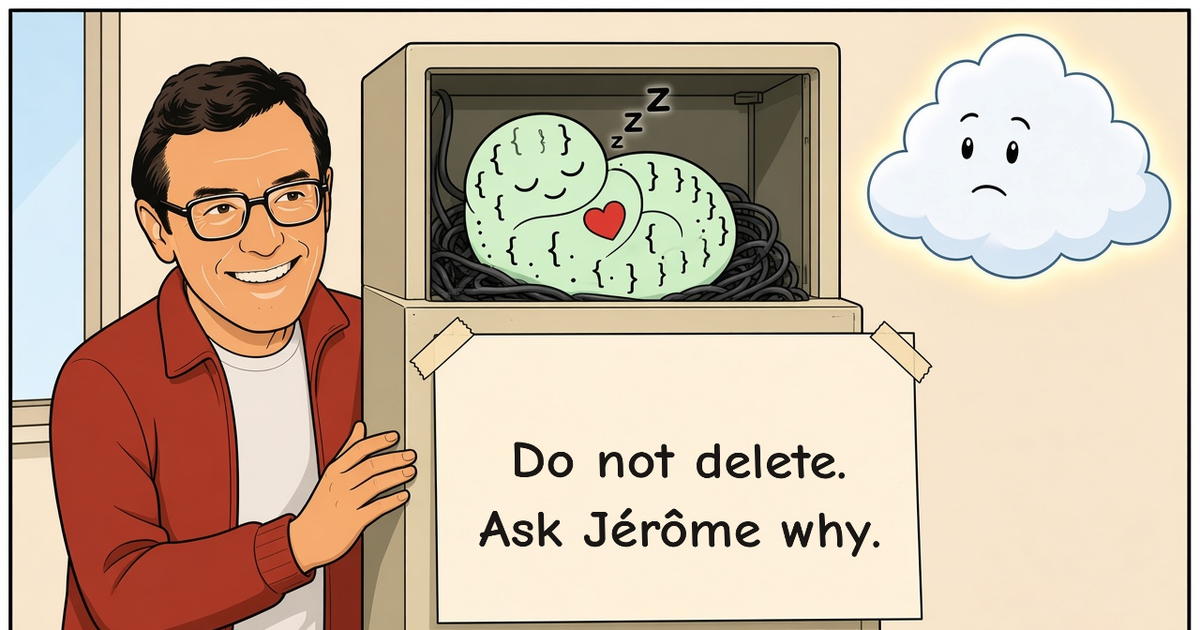
After 22 years with one client, I am closing the book. The code I crafted over those years is being handed over, and much of the future work on it will be done by AI. Watching AI read and change that code taught me something: AI can read every line and still miss the most important part. It sees what the code does. It rarely knows why.
The code says what. People know why.
Most of the programs I built started as a sentence or two in a memo, the so-called specifications. Writing the code was only a few percent of the work. The rest was asking why we were doing this, then peeling the onion: who else is affected, what could break, what happens to last year's data.
That thinking rarely ends up in the code. A line that looks like a mistake may be holding something up. An odd workaround may have stopped a data problem years ago. A strange rule may be there because a customer asked for it once. One example comes to mind. In 2022, a customer wanted to give the proceeds from the sale of certain items in its inventory to charity. A few lines of code, for ONE month. The items sold out, but the code is still there, dormant. The only note above it says who asked for it and for which customer: no date, no explanation.
Is it safe to delete? Will it wake up if those items come back in stock? Only someone who was there knows. Unless someone wrote the reason down, it is invisible. The AI guesses, and so does a new developer. A confident guess about old code is how side effects are born.
I wanted to know if that note was unusual. So, I went back through more than 200 code repositories from nearly ten years, since 2017, mine and my clients’. Ninety-nine percent had no README at all, the short file meant to explain a project. The few that said what the code does and who uses it. Not one said why it was built. I suspect the programmer was told what to do and never told why it mattered.
Those few READMEs looked as if an AI assistant had written them. They were neat and complete, and they explained the code well. But an AI can only describe what is in the code, and the why never was. A document that looks complete can hide the fact that the most important part is missing.
I am not the only one asking
Satya Nadella, the CEO of Microsoft, asked the same question about the knowledge nobody writes down: “We have 200,000 employees and we have, let's say 2 million agents or 20 million agents all in a loop. What is happening? What is the tacit knowledge that gets created?”
Some companies are already paying for skipping that question. In a recent SHL survey of about 2,000 workers in the U.S. and the U.K., nearly one in five American workers said they had been replaced by AI and then asked to come back, and many now want higher pay to return (Fortune, November 9, 2026: https://fortune.com/2026/11/09/ai-rebounding-20-us-workers-replaced-higher-pay-job-security/). Lucy Beaumont of SHL put it plainly: “AI rebounding is what happens when a company automates a role before it has genuinely assessed the human capability inside it.”
Write down the why
The spirit of a system lives in the heads of the people who asked for it, built it, and used it. When they leave, it leaves with them, unless someone writes it down.
Try it this week: pick one thing only you really understand: a piece of code, a spreadsheet, a pricing rule, a process. Write one page: why it exists, what it protects, and what would break if someone “cleaned it up.” Developers can keep it right next to the code, in a small file called WhyThisCode.md. Reread it every time you change something, or it will grow old too.
That page may be the most valuable thing an expert leaves behind, and it is exactly what your AI assistant needs to do the job well. AI can become part of a company's fabric, but only if someone feeds it the history.
Next: “Saving time is good, but only if the time saved is worth something,” on the myth of the hours technology saves us, AI especially.