Agent at work, part 3: I rebuilt my website in a day
Deciding, not coding
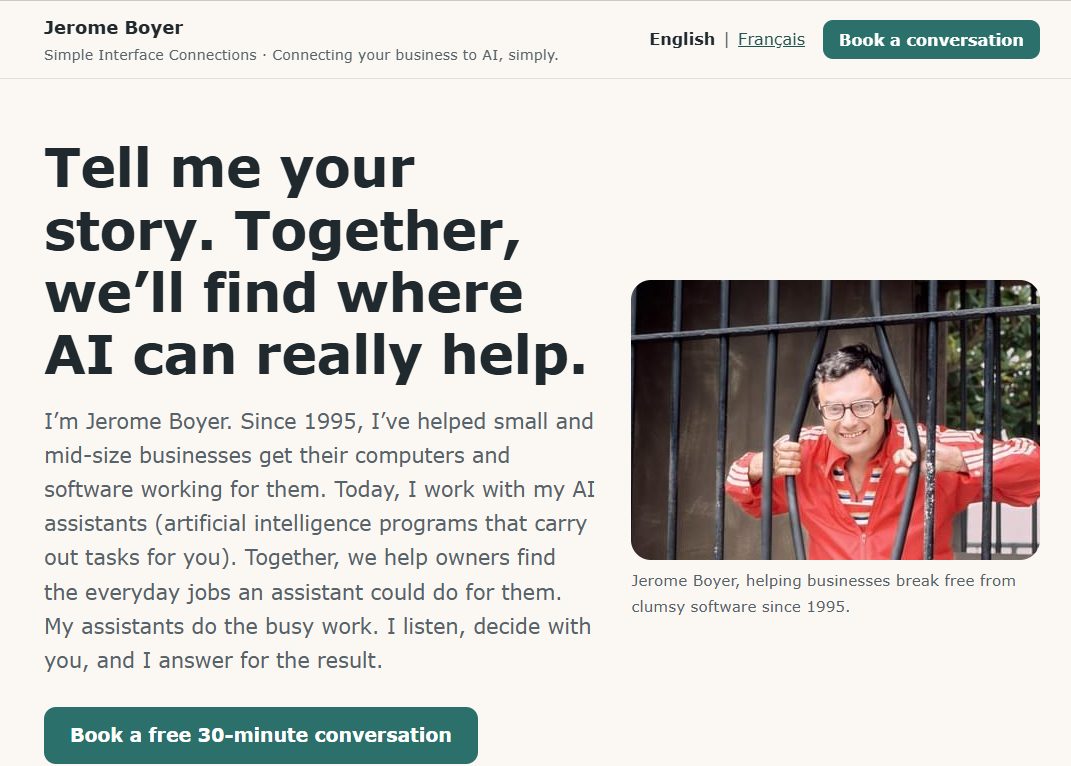
In Agent at work, part 2, my AI assistants helped me improve a small phone app I had already written. This time, the patient was closer to home: my own website.
Could I and my AI assistants rebuild it, from scratch, without me writing code?
The problem
My old site lived on Strikingly, a website builder. It was confusing and too complex. It still pushed SqlLens, a software product that no longer fit what I do. The editor was slow, pasting text didn't work, and I simply didn't like the layout. The worst part was the language: most people got lost after the first sentence.
Meanwhile, my work has changed. After 40 years in business, I am burnt out on programming. Today I help small businesses adopt AI assistants. The website didn't say that.
Telling my story
So I did what I now ask my own clients to do: I told my story. Who I am, what I'm tired of, what I want to do next.
The assistants came back with a simple proposal: a clean, one-page site with ONE action. Book a free 30-minute conversation. Nothing else competing for attention.
I set the rules
Before any work started, I set the rules:
- Plain language, for "monsieur tout le monde" (the average person).
- Full words, not acronyms.
- "I and my AI assistants", not "we".
- No client names. Past work is described in general terms; names only with permission.
- Separate English and French sites.
The assistants respected those rules every time. When something slipped, I pointed it out and it was fixed.
What the assistants did
In about a day, the assistants:
- Built the site from scratch.
- Moved my 11 blog posts over from Strikingly.
- Translated three posts into French.
- Hosted it on Microsoft Azure, on the free plan.
- Connected my address, siconnect.ca, to the new site, without touching my email.
- Added a site map, a file that helps search engines find every page.
- Made a small "JB" icon for the browser tab.
One detail made me smile. Another of my AI assistants, the one that built the book site for my mother, Milka Lodetti-Boyer (lodetti.siconnect.ca), shared how it had set up its hosting. My assistants were learning from each other.
My other “live” assistant, my wife Louise, read the new page, understood it, and asked for a free consultation.
The name stays
I wondered whether it was time to drop the old company name, Simple Interface Connections, from 1995. I kept it, and added a slogan: Connecting your business to AI, simply.
There was also a story I love: in 1995 I invented a kind of precursor to USB, a little too early. The assistants offered to add it. I cut it. It would pollute the simplicity.
Where my judgment mattered
The assistants did the volume. I did the deciding. A few examples:
- In French, should it be "blogue" or "blog"? I asked the assistant's view, then made the call.
- I asked for the explanation in parentheses of what AI assistants are, so a non-technical reader isn't lost.
- In French, I wanted "Je m'appelle Jérôme Boyer", the way I would say it.
- I reordered the blog posts.
- I caught a missing space before "Next".
- I asked why "British Columbia" was on the page, and decided to keep it.
I reviewed the text word for word in Word documents. For the translations, the original was on the left and the French on the right, one paragraph per row. That is how I like to check.
The assistants made mistakes too
I'll be honest about it. At first the assistant told me Google's booking page was free. It wasn't: it needed a paid plan. So we switched to Calendly's free booking page.
It also first said my blog could stay on Strikingly. It couldn't, not the way I wanted. We moved it.
Neither mistake did any harm, because I was checking. That is the point. An assistant is fast and capable, but it is not the one who answers for the result. I am.
It seems, though, that the assistant is “on your side”, so to speak. It tries to guide you based on its understanding of the situation. It is a machine, but it doesn’t feel like one.
What does this mean for you?
In my first post, I said the skill is shifting from knowing the syntax to knowing how to state the outcome clearly. In part 2, I saw it hold for real software. This time it held for something every business owner needs: a website that says what you do, simply.
I didn't write code. I needed to know what I wanted, make the decisions, and check the work.
If your website, or any part of your business, feels too complicated, tell me your story. A free 30-minute conversation is one click away.
Good botting!