Answer or Act: What Business Leaders Say About AI Assistants
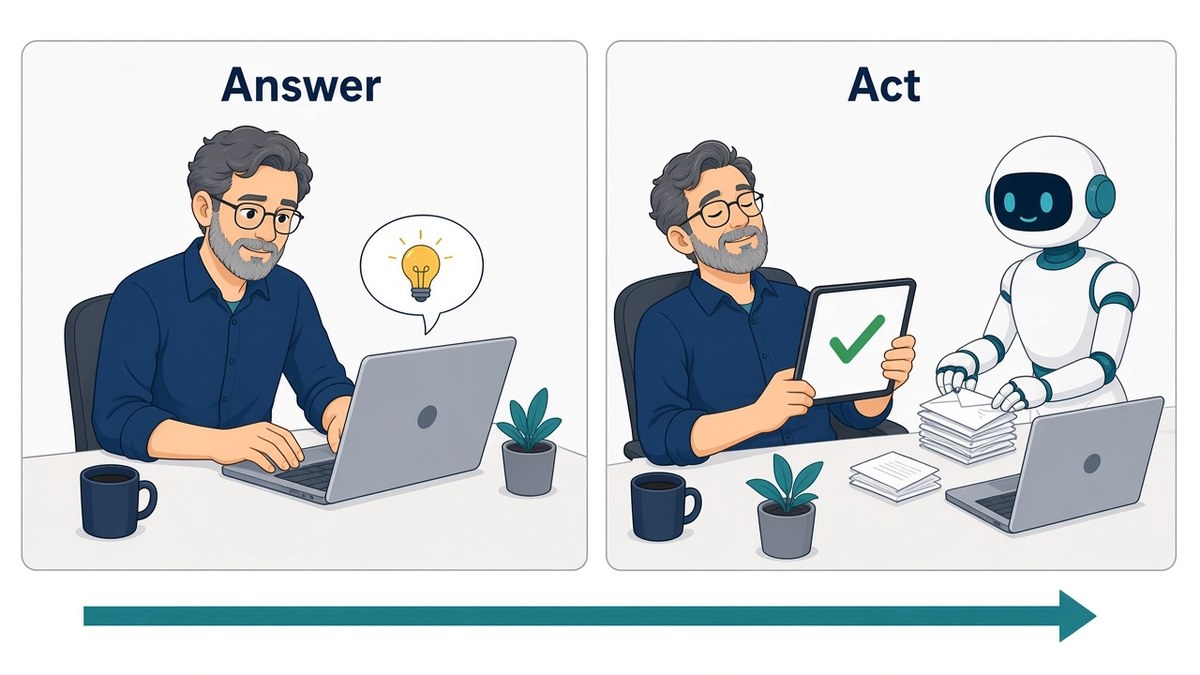
Most people use AI the same way. They type a question, read the answer, and move on. That is useful. But it is only half of what AI can do today.
The other half is AI that acts. It doesn't just tell you what to write. It writes the message, prepares the quote, or follows up with the client, and then waits for your approval.
That is the difference I want to talk about today: answer or act.
Most of us only ask questions
From what I have read, about three out of four people who use AI use it only to get answers. Far fewer have tried AI that acts on its own. A study by Ernst & Young found that 16% had. A report from Menlo Ventures found that 24% use AI agents regularly.
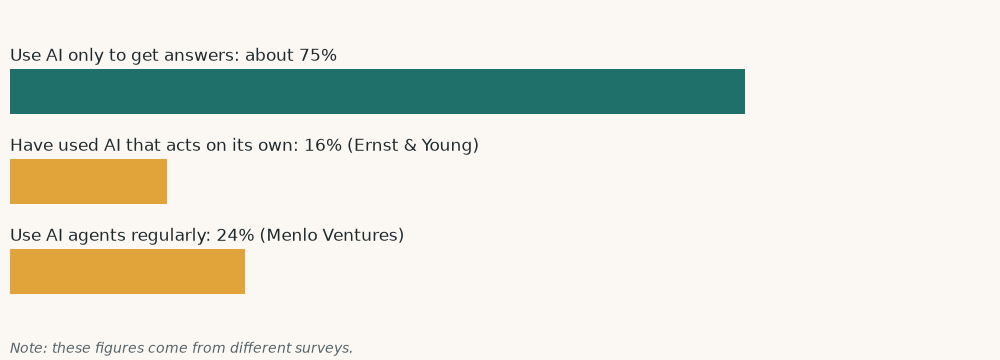
The figures come from different surveys.
What is an "agent"? It is simply an AI helper that can carry out a task for you, not just talk about it. Think of the difference between a friend who tells you how to fix a leaky tap and a plumber who comes and fixes it.
In short, most people still use AI as a super Google. Very few have given it a task to do, even while keeping the final say.
What the leaders see
The people who run the largest technology companies draw the same line I do. Satya Nadella, Chairman and CEO of Microsoft, put it plainly at a conference for software developers in May 2025:
"You can ask questions, and AI assistants give us answers. You can assign tasks to agents and have them execute them, or work side by side with AI to complete jobs and projects." (source)
Ask questions, or assign tasks. Answer, or act.
Andy Jassy, CEO of Amazon, said much the same in a message to Amazon employees:
"Think of agents as software systems that use AI to perform tasks on behalf of users or other systems." (source)
Jensen Huang, founder and CEO of Nvidia, the company that makes many of the chips AI runs on, went further. As reported by Fortune, he told a crowd in Las Vegas in January 2025:
"AI agents are the new digital workforce." (source)
And Sam Altman, CEO of OpenAI, the company behind ChatGPT, wrote at the start of 2025:
"We believe that, in 2025, we may see the first AI agents "join the workforce" and materially change the output of companies." (source)
These are not small voices. When they all point the same way, it is worth paying attention.
Hammer, toolbox or assistant
In Staying Afloat as AI Rises, I described three ways people use AI: as a hammer, as a toolbox, and as an assistant. The hammer and the toolbox both give you answers. Only the assistant understands what you need and acts on it.
Marc Benioff, Chair and CEO of Salesforce, described that third way like this:
"Agentic AI is a new labor model, new productivity model, and a new economic model." (source)
In plain words: AI that acts changes who does the work, not just how fast you find information.
Acting means approving
Here is the part that matters most to me. If AI acts for you, you must stay in charge.
Katelyn Lesse, a software engineer, wrote about this recently for other engineers. She asked:
"If multiagent systems are working for weeks, how does the human meaningfully approve what their agent can do?" (source)
Put simply: when AI helpers work for you over days or weeks, how do you decide what they are allowed to do, and how do you stop them if something goes wrong? She also calls for "kill switches", which is just an off button that really works.
A Salesforce manager said it even more simply on the same page as Mr. Benioff's quote: "You wouldn't hire an employee you don't trust."
That is why I and my AI assistants follow one firm rule: the owner approves every message before it goes out.
Take my friend's adventure tour company. When a customer writes about a trip, the assistant prepares the reply. When the customer signs up, it prepares the checklist to send before departure. After the trip, it drafts a thank-you note and asks for a review. My friend reads and approves each one. The assistant does the work. He keeps control.
What this means for a small business
You don't need a team of engineers. You don't need to change everything at once.
Start with one task you repeat every week. Let an assistant do it. Read what it prepares, approve it or fix it, and see how much time you get back. Then add a second task.
That is the shift from answer to act. It is not about replacing you. It is about giving you an assistant that does the work while you make the decisions.
Let's talk
I and my AI assistants can show you what this looks like for your business, using your own tasks.